CHIPP prize 2025: Top precision for top quarks
University of Zurich graduate Chiara Savoini wins CHIPP PhD prize 2025
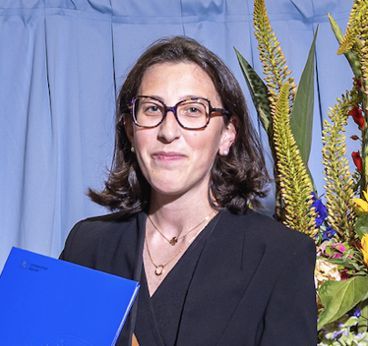
Some researchers find motivation in answering open questions about Nature, while others are driven by the challenge of solving complex technical problems. Chiara Savoini combined both in her PhD research on top quarks—the heaviest known elementary particle—which earned her this year’s CHIPP prize.
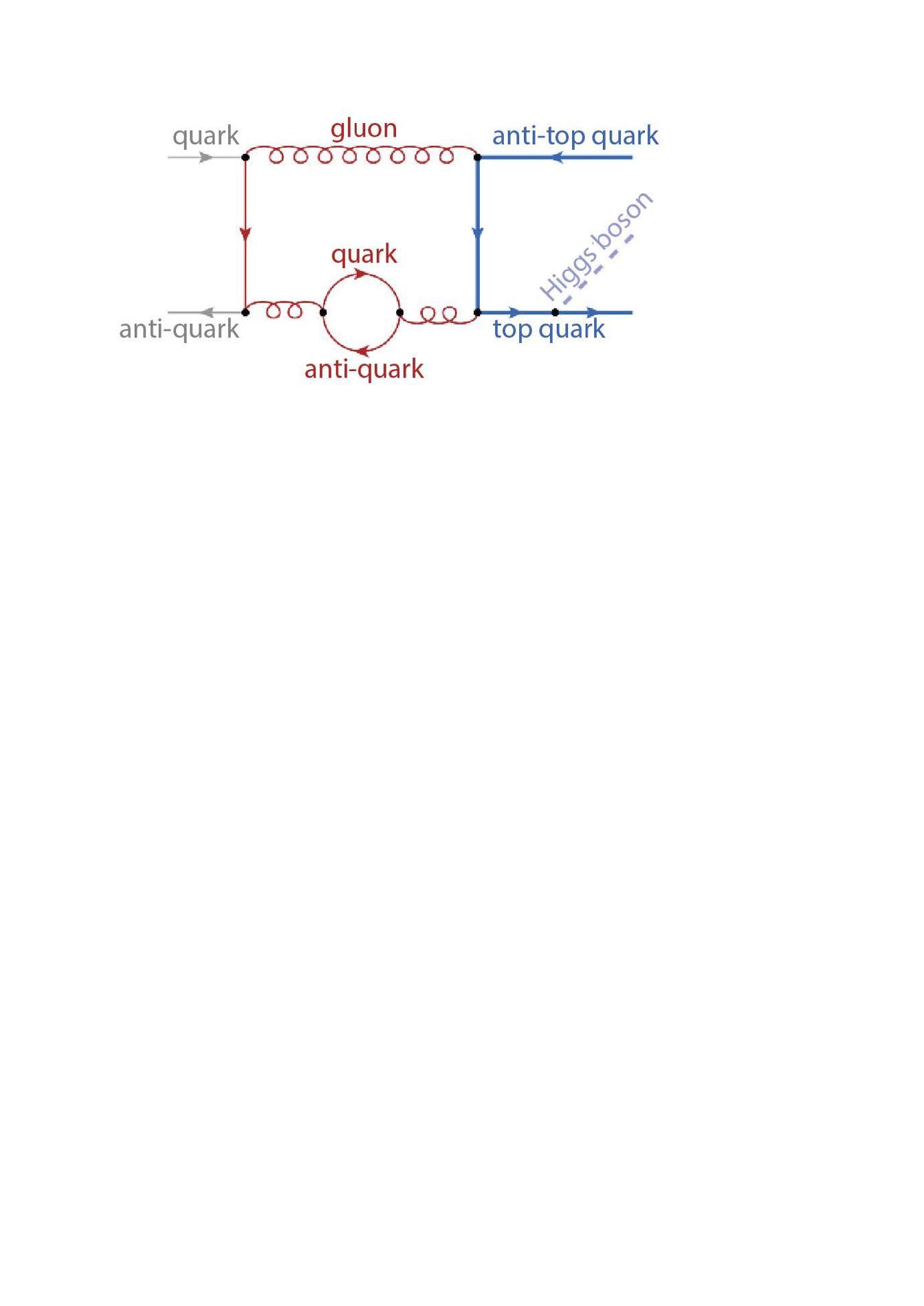
The top quark is the heaviest among the six quarks predicted by the Standard Model. Produced in high-energy collisions at the Large Hadron Collider (LHC) at CERN, it decays in less than 10-24 seconds. Because of its large mass, the top quark strongly couples to the Higgs boson, a particle born from the mass-providing Higgs field. Uncertainties in the top quark properties also affect precise measurements of W and Z bosons, mediators of the weak interaction. So, the top quark is an important participant in many interactions predicted by the Standard Model. Any deviation from these predictions observed in an experiment could open the door to new, undiscovered physics.
The very short lifetime makes the top quark extremely hard to study, but also gives it a unique advantage: while lighter quarks are confined by the strong force into hadrons, the top quark remains in a free state as it decays before any binding can occur. By studying its decay products, physicists can probe the top-quark properties and reveal how it interacts with other particles.
Already in high school, Chiara’s favorite subjects were mathematics and physics, so studying theoretical physics felt like a natural choice. She went on to study it at the University of Milan in her homeland, Italy. “I wanted to remain connected to the formal and theoretical side of mathematics, yet also have an impact on experiments and our understanding of nature,” she recalls. At first, she was not sure which area of physics to choose. That changed during her Bachelor’s thesis: as soon as she began working on particle physics, she was hooked.
After her studies in Milan, Chiara joined the group of Professor Massimiliano Grazzini at the University of Zurich. Her PhD project aimed to make more accurate predictions of top-quark pair production, the primary way these particles emerge at the Large Hadron Collider. Indeed, when two protons collide at high energy, a pair of particles—a top quark and its antiparticle, the anti-top quark—can be created with a certain probability. Theorists can predict this probability, called cross-section, with high precision. However, top quarks decay so quickly into lighter particles that they never reach the detectors as free particles. In the quantum world, if a particle lives only for a very short time, its energy becomes less certain. Therefore, to reliably compare theoretical predictions with experimental measurements, it is essential to take this uncertainty into account. This became the first project of Chiara’s PhD.
She devoted more than a year to this problem, but the solution kept slipping away. “We soon realized that the complexity of this project was higher than expected. This was not an easy period for me: at the beginning of the PhD, I expected to follow a clear path, but suddenly I found myself stuck, unsure how to continue,” Chiara recalls her frustration.
After a year, she and her supervisor made a difficult but constructive decision: to put the project on hold and redirect their efforts toward new and exciting problems that promised fresh opportunities. What helped her through that period was the people around her and the supportive atmosphere in her research group. “In a good environment and with supportive mentors, there are always opportunities to learn, get results, and become motivated again.”
For her fresh start, Chiara decided to set aside the short lifetime of the top quarks and treat them as stable, removing a layer of complexity. This simplification opened the door to new, experimentally relevant questions: what if a top–anti-top pair is produced alongside a heavy boson, like the Higgs or the W? How would interactions between these particles affect the probability of such an event? Any discrepancy between theory predictions and LHC measurements could hint at previously unknown interactions among these heavy “champions” of the particle world—and help us better understand the pattern of masses of different particles in the Standard Model.
To study such potential discrepancies, both theory and experiment must become increasingly precise. With the upcoming upgrade of the LHC, theorists face the challenge of keeping up in this accuracy race. “The LHC has turned from a discovery machine into a precision machine. So, we try to improve theoretical accuracy as much as we can,” Chiara explains. To predict a cross section with high precision, theorists must include not only the simplest contributions that give the bulk but also subtler corrections, which are much harder to evaluate. It’s like the 80-20 rule: the first 20% of the effort gives 80% of the result, but each additional step toward full precision requires disproportionately more work. Unlike in everyday life, where 80% is often enough, high-energy physics demands going further to reveal new insights about nature.
Top-quark pair production in association with a Higgs or W boson involves a tricky type of these subtler corrections, known as the two-loop contribution. Its exact computation is beyond the reach of current techniques, and for many years, this roadblock kept theorists from improving the precision of their predictions. Chiara’s goal was to follow in the footsteps of generations of physicists before computers existed: find a clever way to approximate the unknown term without brute-force calculation. She devised an elegant solution, jokingly calling it “gripping the unknown term with pliers.” She considered two extreme situations: one where the boson carries very low energy (the soft limit) and another where the top quarks can be treated as effectively massless (the high-energy limit). In both cases, the calculations simplify, allowing her to compute the complete cross section for these processes at higher precision. Even though in real experiments, the process lies somewhere in between, she could constrain the two-loop contribution between these two extremes and estimate it with very high confidence. This new prediction became the new theory reference for experiments.
This clever approximation earned Chiara Savoini the CHIPP Prize 2025. But it was also a crucial step toward answering her original PhD question—how the short lifetime of the top quarks affects their production at the LHC. Having developed a method for one problem, Chiara found a new way to tackle the more complex one. She published the first results just a few months ago. “One can spend months on a problem without success. But sometimes it's better to leave it aside and concentrate on something else. When you get back, you have more motivation and newer ideas to restart the project and obtain some nice results,”—a lesson she learned during her PhD.
“Chiara has been an outstanding PhD student,” says her supervisor, Professor Massimiliano Grazzini. “We started with a very ambitious project, which I knew would be a lot of work. She immediately got involved in other projects, grew up as a researcher, and managed to obtain results for the most complex project of her PhD. She is very determined and wants to understand everything in depth, and in the end, this pays off. I’m extremely happy that she got this prize. I think she has all the qualities needed for a career in academia.”
A year ago, Chiara began a postdoctoral position at the Technical University of Munich, ready to tackle the next challenge. Her clever approximation of the two-loop corrections already pushed theoretical precision far beyond previous limits—but calculating these terms exactly could take it even further. “We are still missing this contribution to provide the final cross-section prediction for experiments,” she explains. “First, we have to fully understand the physics behind this complex process and develop the necessary computational techniques. This is one of the main challenges I would like to tackle in the near future.”