Behind the Scenes of the Large Hadron Collider Upgrade
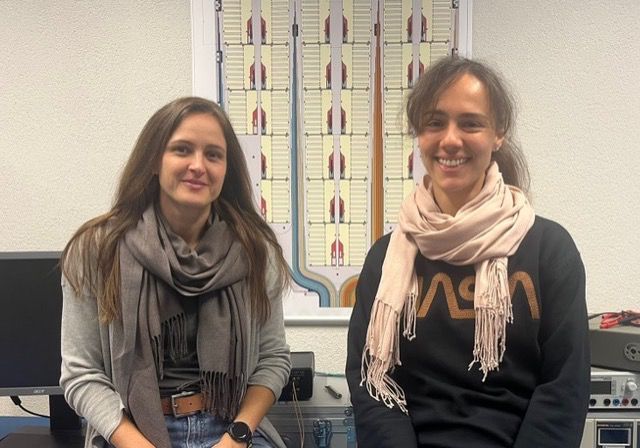
The Large Hadron Collider, or LHC, is a huge accelerator used by several detector collaborations with over 10,000 scientists to advance our understanding of fundamental physics. While we often cover news like the measurement of new particles or the precise determination of fundamental constants, today we would like to focus on the less visible work needed for the LHC detectors to function. We are speaking with Dr. Silke Möbius, a postdoctoral researcher, and Camilla Tognina, an electrical engineer, who are developing a read-out system for the new inner detector (Inner Tracker) of the ATLAS experiment. This project started in 2018 in the group of Professor Michele Weber at the University of Bern and involved in total 37 people at the various stages of the project.
Aleksandra: Let’s start with the big picture. ATLAS is the largest detector designed to detect and characterize high-energy particle collisions. Why does ATLAS need a new inner detector with a new read-out system?
Silke: The Large Hadron Collider is going to be upgraded by 2030. The idea is to get more particle collisions in each beam crossing to be able to observe rare new phenomena that are so far not visible with the current statistics. For ATLAS, this means that there will be a lot more particles flying through the detector. The current Inner Detector cannot handle this; it’s just not fast enough, and not granular enough to see where each particle came from. So we have to build the Inner Tracker (ITk).
Aleksandra: ATLAS is a huge detector, and many groups are working on its upgrade. Which parts are you working with?
Silke: Yes, ATLAS consists of many layers. You can think of it as cans of different sizes stacked into each other. The Inner Detector measures where the particles collide and where the newly created particles go. Around it, we have two different calorimeters, which, true to their name, measure the particle’s energy. And the biggest part is the muon system, which detects muons, particles that pass through all other systems unstopped.
In our work, we only care about the upgrade of the Inner Detector, which will be replaced in 2028 during the next LHC long shutdown. For this detector, the ITk, we work on the innermost part, the pixel system. And also there, we don’t work on the modules that actually detect the particles, but on the read-out system.
Each time a charged particle passes through the detector, we see electrical signals. We need to get these signals from the cavern, which is deep underground, to the computers, so we can do something with it. However, we can only have a maximum of six meters of electrical cable. After that, the signal degrades too much to be useful. That’s why we developed the Optosystem that converts an electrical signal to an optical one, which can travel with smaller losses for much larger distances.
Aleksandra: What were the biggest challenges in developing this read-out system?
Camilla: After the upgrade, there will be about three times [CT1] [MS(2] more collisions per beam crossing than now. In addition, the density of the pixels will be higher. This leads to a data rate much higher than in the current detector. Since the current system cannot just be extended, everything needs to be redesigned in a more efficient way with modern high-performance components.
Furthermore, so close to the collision point, the radiation is very high, so the electronic components need to be radiation-hard. There exist chips that are developed exactly for this at CERN. Our task is to put them together in a way that fits inside the detector and that fulfills the task of recovering all the signal and converting it to optical.
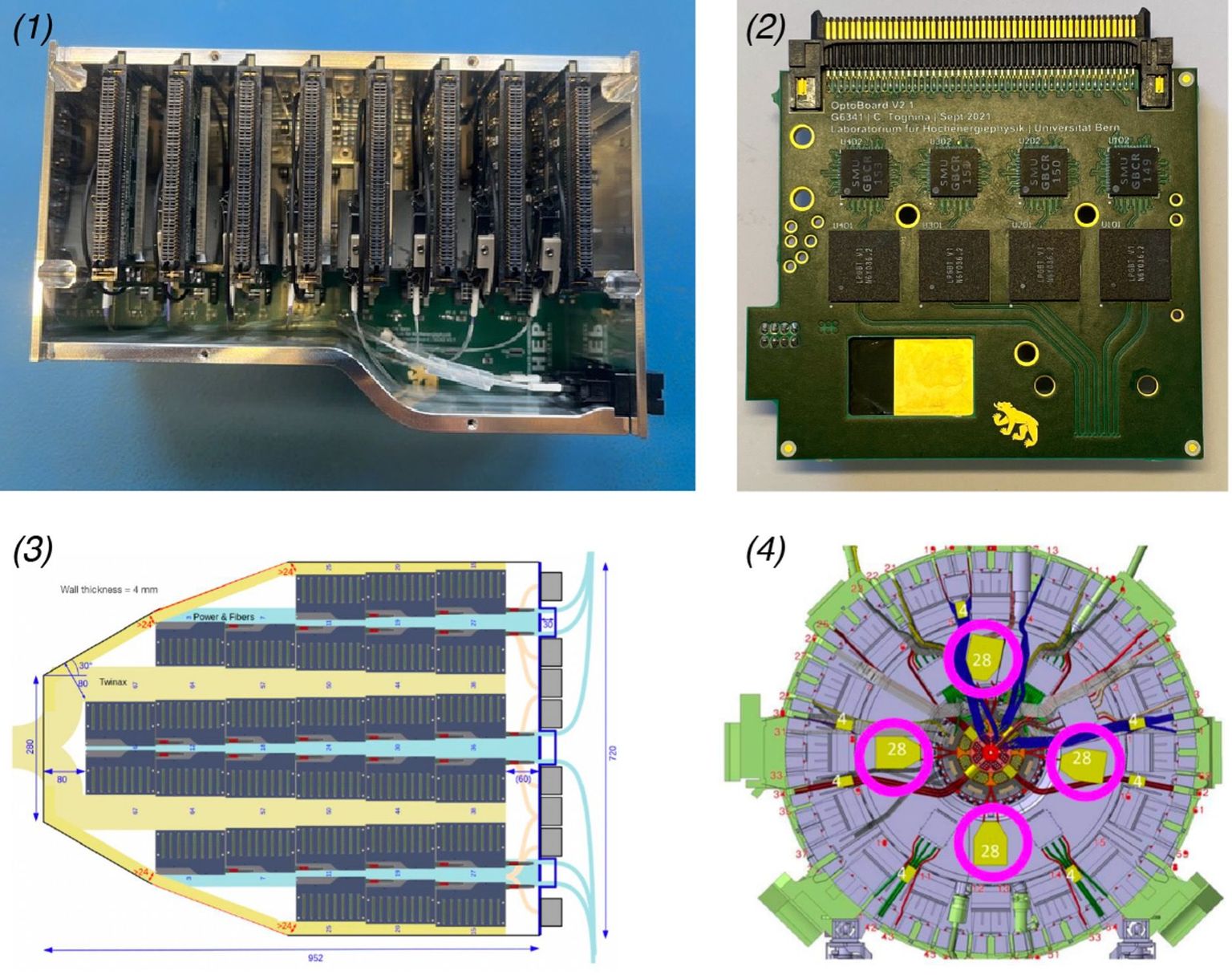
Silke: We were also limited by the geometry of the detector. As I mentioned, ATLAS is built of many subsystems that form several layers stacked onto each other. Our read-out system is supposed to be situated outside of the ITk so that the radiation is tolerable. This means that we need space in between the separate layers of ATLAS to fit our Optosystem. As the detector still needs to be functioning, there are a lot of mechanical constraints on how large and where the Optopanel is allowed to be.
Aleksandra: This seems like a lot of things to think about. Can you give us a peek into the development process?
Camilla: At the beginning, it was a lot of brainstorming together with mechanical and electrical engineers and physicists. Just working on a blackboard and putting ideas together. We had to find a useful logic to connect all the chips, powering, and mechanical components together, such that they fit the space.
Silke: And then we also wanted to make the system modular, so that if one element fails, it doesn’t stop the whole detector.
Camilla showed me the system that they developed. You can see it in Figure 2: a single module, the Optobox, contains eight Optoboards – the main port of the read-out system. Each Optoboard has four chips that restore the signal after it has travelled for six meters from the detector. After that, the signal is serialized and is passed through the optical module that converts it to an optical signal. All Optoboxes are then arranged on the Optopanel that will be placed inside the detector.
Aleksandra: When you made the design, you needed to test that everything worked together, right? How does this process work in the ATLAS collaboration?
Silke: To test that the read-out works, we wanted as fast as possible to have the first version of the actual detector module, developed by other teams in ATLAS. Testing is not just about the signal; it’s about the entire path with all the cables and connectors.
In the process, there are always some developments. For example, we saw that our initial design didn’t make sense mechanically, because we couldn’t open the Optoboxes anymore once they were screwed on the Optopanel. But after we passed the final review, the design became frozen. Next, we plan to go through a Production Readiness Review, where we need to show that 10% of the Optosystem has been produced and passes all the quality control checks. That’s what we are working on right now.
We test every component that comes in. Then we screw the whole Optobox together and test the Optobox. Finally, we put it in an Optopanel and test it again. My main task is thinking about how we can deliver our system on time and functioning. For that I need to think about what we need to test, how to do this best, and make sure that everything is nicely documented.
Aleksandra: Do you produce the Optoboards yourself?
Camilla: No, for the entire detector, we will need about 2200 Optoboards. Although we can do quite a lot here by hand, there are some very small components on the boards. If we want to ensure the quality, we need industrial production. We had the first 10% produced in the company that will do the mass production, so if there are problems, we figure them out now and not during the final production.
Aleksandra: I see that to develop and test your system, you needed to coordinate with other teams within ATLAS. How does it feel working in such a large collaboration?
Camilla: In a huge collaboration, everyone needs to be ready on time, right? If someone is behind schedule, then everyone else is held up. So far, luckily, that hasn’t been us, but this can be a challenge.
Silke: Also, there is a limited number of all components. For example, to test our Optosystem, we need detector modules. However, 20 other sites need these modules too. Fortunately, our management structure ensures that every group gets everything they need. It’s challenging, but it’s also great to collaborate with all the other institutes. I’ve always liked the fact that you have colleagues from all over the world.
Author: Aleksandra Nelson