Uncle Scrooge discovers particle physics
Researcher from ETHZ brings muon tomography to children’s comics and has another big project in the works…
Sometimes it takes a simple idea to get science concepts into children’s minds. When the world was in lockdown and parents everywhere juggled home schooling their kids, getting their own work done and keeping everybody happy and healthy, scientist Luigi Marchese thought back to his own childhood and had an idea. Why not combine what he loved as a child – reading comic books, especially the Italian “Topolino” magazine featuring Mickey Mouse, Donald Duck and co – and what he does as an adult – doing particle physics at the CMS detector – to keep kids edutained?

He contacted Panini, Disney licensee and the Italian publisher of the Topolino comic books, and a collaboration was born. He worked together with the comic-book designers and children’s-story experts from Panini on different storylines, looking both at the big picture and at the scientific details. “Of course it turned out to be more complicated than I had expected,” Luigi Marchese, who is a scientist at ETH Zurich, recalls. “But in the end one story prevailed featuring Scrooge McDuck, his Money Bin, the Beagle Boys and – a first! – a muon detector.
And the story goes like this: after a failed break-in attempt into the Money Bin featuring explosives, Uncle Scrooge is worried about structural damage to the metal beams inside the Money Bin’s walls that could expose his riches to the elements. As he doesn’t know how to check this, he calls on inventor Gyro Gearloose who, obviously, has an answer ready: a kind of gigantic mobile X-ray station using particles from space to check whether there is any damage to the iron structures inside the walls. Gearloose solicits the help of the renowned institute CERP “Centro Di Eminenti Ricerche Paperopolesi ” (i.e. “Institute of Duckburg Eminent Research”) who provide him with the necessary technology… but also ask for some funding for future projects in return.
Muon tomography, however, is a slow process and it takes five weeks to see the results (which, spoiler alert, show only minor damage) of the muon tomography of the money bin. In order to distract the Beagle Boys, Uncle Scrooge tricks them with a fake treasure map that takes them to a remote island where they also try the muon radiography technique to “see through walls” in order to find the cave with the treasure… to no avail. The story ends in a well-earned jump into the Money Bin.
There were two more science storylines that made it into the kids’ magazine: one about searching for life on Mars and one about Uncle Scrooge looking for gold being made from neutron-star merging producing gravitational waves. “It’s all based on real ideas and proper science, but with a comic twist,” Marchese says. The muon story attracted the interest of a few schools in Switzerland and the Consulate General of Italy in Zurich. Marchese met with the teachers and the Scientific Advisor of the Consulate to develop a spin-off project: “Topolino e le Scienze”. The science contents were integrated into the science curriculum and studied in class through the year. The project culminated in the children being able to ask questions about the science contents. “I got 200 questions!” Marchese says. “I met the kids because I would rather give my answers directly to them. The funniest question was if we can eat particles. I was also delighted to see the ring of the Future Circular Collider among their drawings, “the place where they dream of doing my job” . This was a really rewarding experience, from an idea born during lockdown to inspiring the next generation. Quacktastic!”
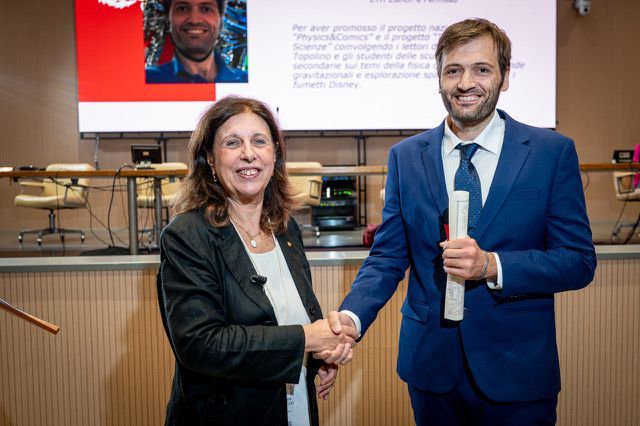
He was recently awarded the Italian Physical Society’s Science Communication Award for his original projects. Marchese is currently working, together with Ana Godinho, on a new project on particle physics and comics, after receiving a grant from the Swiss National Science Foundation. We will let you know when the new stories launch – which will probably happen in about three years’ time and will include augmented reality features.
Info box muon tomography
Muon tomography and muon radiography are imaging techniques that use particles from space to map the inner structure of very thick objects. The particles (mostly protons) collide with atoms in the atmosphere, producing particles such as muons. Muons are the heavier brothers of electrons and have the ability to pass through meters of limestone rocks … like those the Egyptian pyramids are made of! They are among the giveaway signs of a Higgs boson being produced at the LHC and detected by the CMS experiment. Marchese worked on the Higgs boson and muons at the LHC. However, these are from collisions in particle accelerators, while muon tomography and radiography use cosmic muons that come from collisions in the Earth’s atmosphere, when cosmic rays hit atmospheric nuclei and produce muons in the process. Sometimes when these pass through an object, they are absorbed or scattered, and they scatter differently depending on the material density. This can reveal hidden chambers or structural features. This was done in Egypt’s Great Pyramid or for a number of volcanoes to monitor their internal structures. Multiple scattering muon radiography is being studied to investigate and image the iron reinforcements inside the masonry of the dome of Santa Maria del Fiore in Florence, Italy, helping preservation without destructive methods. The dome was the direct inspiration for the study of the Money Bin in the comics magazine.
Barbara Warmbein